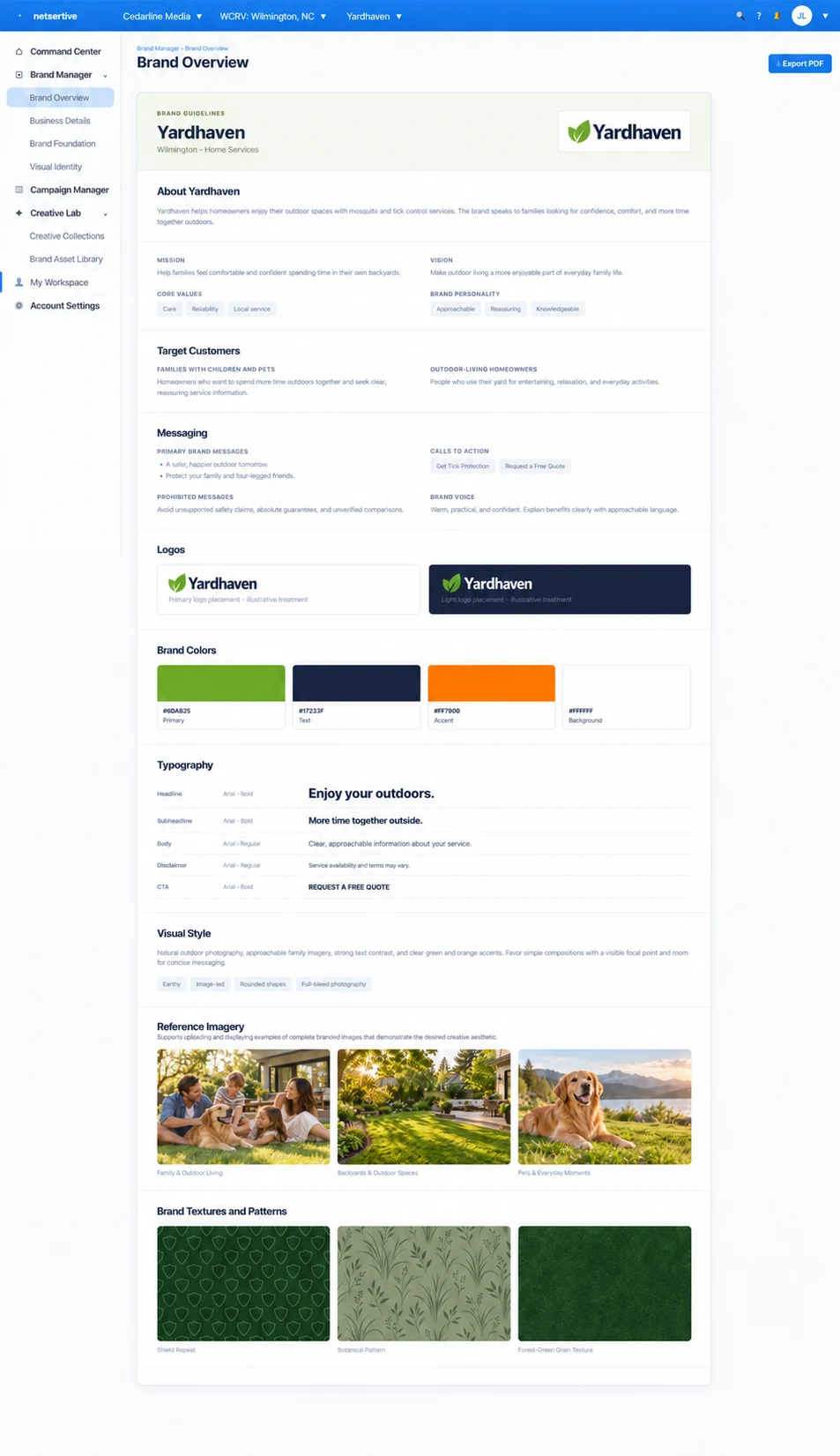
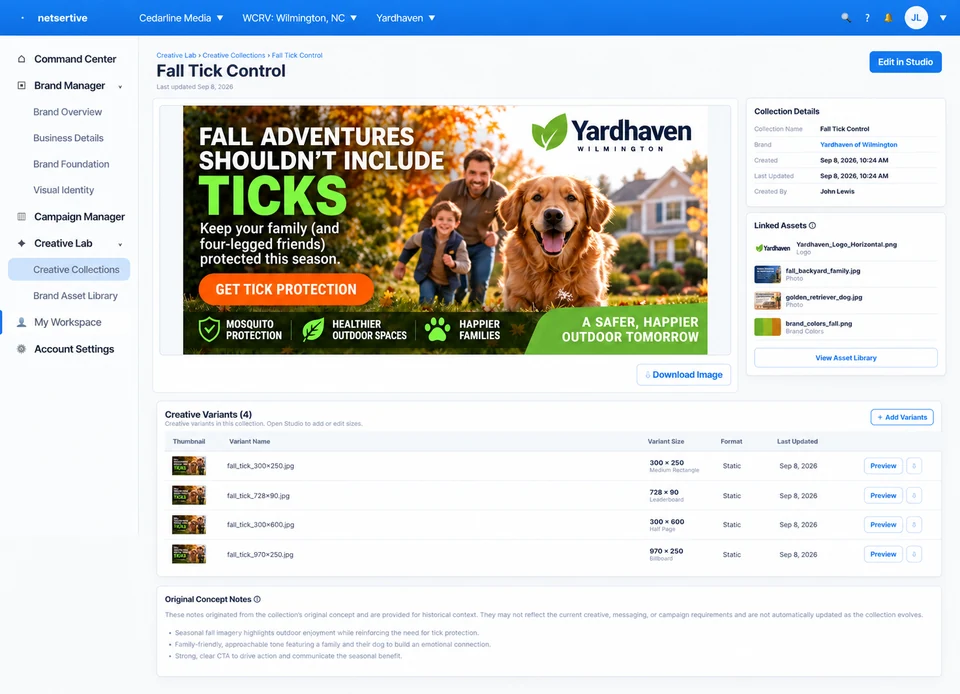
Figma prototype · Business identities replaced for this portfolio.
At a glance
The challenge
Connect brand information, concept creation and campaign preparation across a growing product.
My approach
Design the relationships between tasks, then make them tangible in a connected Figma prototype.
The result
Approximately 22 screens prepared for engineering handoff and prospective-customer presentations.
A product that starts with the brand
A creative team needs more than a place to generate an image. It needs brand information it can reuse, a way to refine concepts, and a clear path toward a campaign. Creative Intelligence Manager brings those activities together through Brand Identity Engine and Creative Lab.
I joined with a set of required fields and two early reference mockups. My task was to turn those starting points into a product people could navigate: organizing the information, defining the steps and connecting the screens.
Designing the experience between the screens
I defined the initial information architecture, forms, workflows and screen states across both modules. I used Netsertive’s existing product conventions as a visual foundation, then built clickable Figma prototypes to show how the experience worked from one task to the next.
I focused on the moments between tasks: using a saved brand to start a concept, continuing through revisions, and organizing the resulting assets. Designing those transitions gave the individual screens a clear place in the larger workflow.
Set up the brand once. Put it to work.
Give brand information a home. I organized the reusable brand record in Brand Identity Engine, with Creative Lab focused on the work created from it. That separation gave each module a clear purpose while keeping the experience connected.
Carry context into the next task. Build with AI brings saved customer profiles, primary messaging and calls to action into the creative brief. I designed this connection so brand setup could support the next task rather than require people to enter the same guidance again. The review screen then keeps revision attached to the generated collection, carrying the workflow from setup into refinement.
Design beyond generation. I connected concepts with collections, asset organization and campaign handoff. Generating a concept is one moment in a longer creative workflow; the surrounding experience needs just as much attention.
Making the prototype a working conversation
I worked through successive reviews with the publishing director and engineering project manager, with additional input from the CTO and an internal marketer. The prototype gave us a shared way to examine the flow and resolve questions as the scope evolved.
As requirements became more specific, I incorporated stakeholder-directed revisions and prescribed mockups into the prototype.
Concept generation was a key example. We worked through what someone needed to provide up front, what could come from saved brand information, and how revision should continue the same task. I revised page connections and screen behavior as those decisions took shape.
We chose Google Fonts rather than uploaded font files to avoid the licensing concerns associated with uploads. I incorporated the supported catalog into the Visual Identity screen, keeping typography selection within brand setup.
From early requirements to engineering handoff
Across multiple rounds of design and review, I created approximately 35 screens, with approximately 22 retained for engineering handoff and prospective-customer presentations.
The handoff brought the initial UX together in a navigable prototype: brand setup, creative work and the relationships between them. It gave the team a concrete product direction to carry into development.
Reflection / Next Steps
This project reinforced the value of prototyping a complete task early. A screen can look resolved while its place in the workflow is still unclear. Connecting the screens exposed those questions and made our review sessions more productive.
The next design step is to put the core journeys in front of intended users, focusing on the transition from brand setup into concept creation, revision and asset handoff.